Search "best vacuum" and you get a hundred reviews written for somebody who vacuums one apartment on Sunday. They measure suction on a strip of test carpet, count decibels in a quiet room, and hand out scores. None of that answers the question you actually have, which is this: which machine will still be working in eighteen months, after four houses a day, five days a week, dragged up and down stairs, jammed into a car trunk, and used by someone who is being paid by the job and cannot afford to go slowly.
That is a different question, and it has a different answer.
The number that matters is minutes per house, not suction
Here is the honest way to think about a work vacuum. You are not buying cleaning power. You are buying minutes. Every design decision on the machine either gives you minutes back or takes them away, and across a week the difference is enormous.
Take one example that never shows up in a review score: the length of the cord. A short cord means you unplug and re-plug in every room. Say that costs you forty seconds each time, and say a three-bedroom house has six outlet changes. That is four minutes. Four houses a day, five days a week, and you have spent more than six hours a month walking to a wall socket. Six hours is most of a working day. The cord is not a detail.
Same with the wand. A wand that does not reach under a bed without you getting on your knees will make you get on your knees four times a house. A hose that kinks makes you stop and shake it out. A dustbin that needs two hands and a trash bag makes emptying a chore you postpone, and a full bin cleans worse.
So before anything else, ask about every feature: does this give me minutes or take them?
Upright: still the sensible default for carpet
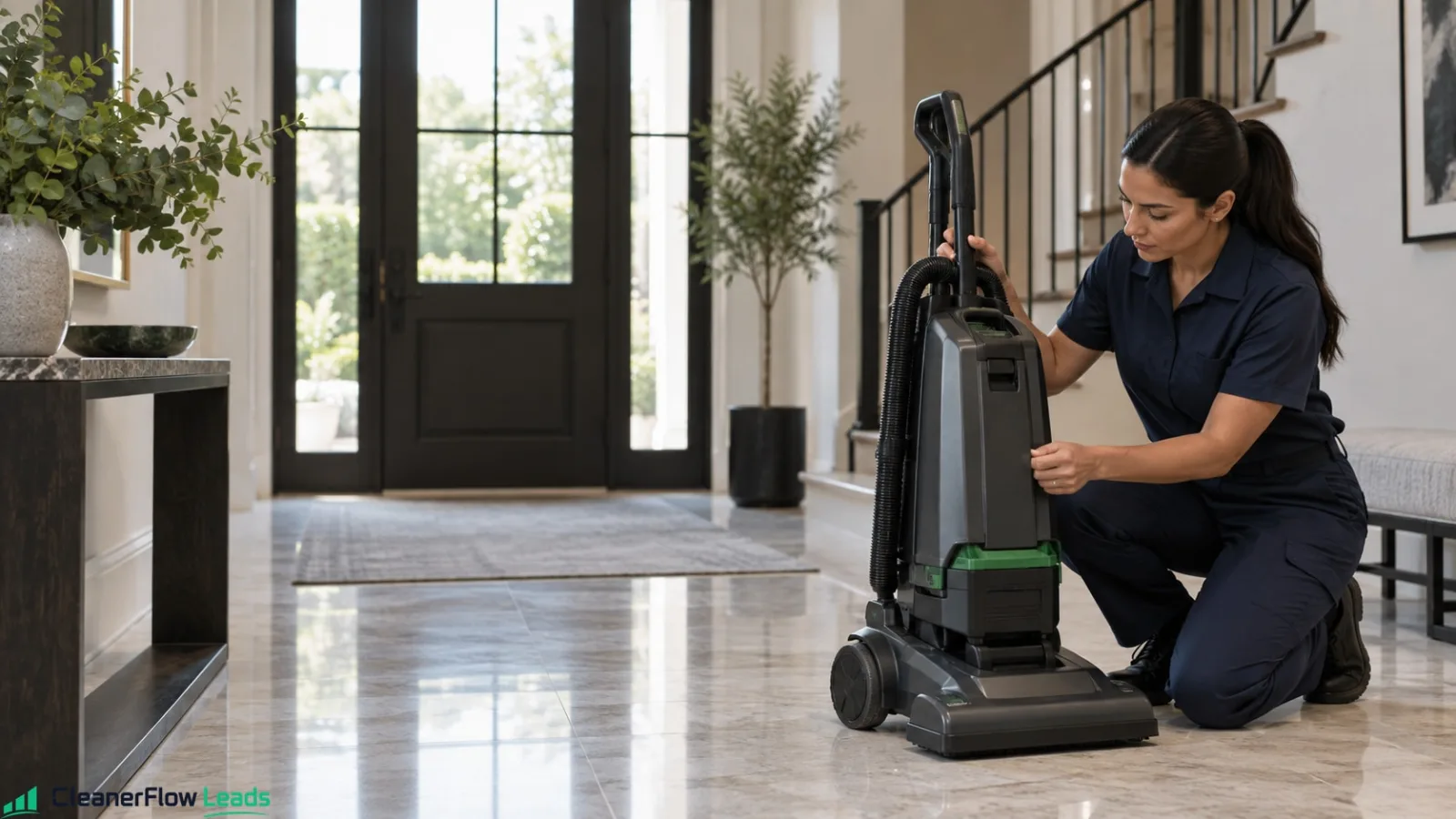
There are four shapes on the market, and each one is right for a different kind of work. The upright is the classic. It is strong on wall-to-wall carpet, easy to push in a straight line, and the cheapest way to get real carpet agitation from a beater bar. It is also the heaviest to carry up a flight of stairs, and it is clumsy under furniture. If your work is mostly carpeted homes on one level, this is still the sensible default.
Canister: better under furniture and on stairs
The body rolls behind you and you hold a light wand. A canister is much better under furniture, much better on stairs, and much better on hard floors, which is most of what you actually meet in a modern house. The trade-off is that the body catches on door frames and table legs, and you learn to carry it rather than drag it.
Backpack: the fastest shape on open floors
You wear it. This is what commercial crews use for offices, and the reason is speed: nothing to push, nothing to catch, both hands free, and you walk straight through a floor plan instead of turning a machine around. It is the fastest shape by a distance on open floors. It is also the shape most people refuse to try, and it does nothing for you on a deep carpet clean because there is no beater bar on most models.
Cordless stick: the second machine that earns its place
Wonderful for touch-ups, turnovers, and the last ten minutes of a job. The battery is the whole story: a stick that gives you twenty minutes on full power is a second vacuum, not your main one. Plenty of professionals carry one alongside a corded machine and would not give it up — for stairs, for a car, for the quick pass after you have moved furniture back.
Short-term rentals change the math
If you clean short-term rentals, read the cordless section again. Turnovers are short, frequent, and full of stairs. A light machine that starts instantly beats a powerful machine you have to set up.
On a turnover the vacuum is rarely the longest task — linens and bathrooms usually are — so the goal is a machine that never becomes the bottleneck. Keep it charged, keep a spare filter with it, and it will be ready before you have finished stripping the first bed.
Cord length: the most underrated spec on the box
Twenty-five feet is short. Forty feet and up changes the job. Every extra stretch of cord is an outlet change you do not make, and you already know what outlet changes cost you. If the machine you like comes with a short cord, find out whether a longer replacement cord is sold for it before you give up on the model.
Weight: carry it before you love it
Anything you will lift up stairs four times a day should be light enough that you are not dreading the fourth time. A heavy machine does not just tire you out — it makes you work around it, and working around your equipment is how jobs run long.
Filtration: sealed HEPA is a selling point
A sealed HEPA system captures the fine dust that a cheap bag blows straight back into the room. There are two reasons to care. The first is that you breathe that air all day, every day, for years. The second is commercial: "sealed HEPA filtration" is a sentence you can put in a quote, and it is worth real money to a client with asthma, allergies, or a baby crawling on the floor. Many cleaners have the feature and never mention it.
Bagged or bagless
Want leads in your area, not just theory?
Apply to buy cleaning leads →Bagless saves money on consumables and costs you a cloud of dust every time you empty it, usually outdoors, usually in the wind. Bagged costs a few dollars a month and keeps the dust captured. For allergy-sensitive clients, bagged is the professional answer.
Noise, and why suction figures are mostly noise
Noise is not vanity. A quieter machine lets you work while a baby naps or a client takes a call, and that is the difference between being invited back and being scheduled around.
Suction figures, on the other hand, are largely noise as a comparison tool, because manufacturers measure them differently and the number at the motor is not the number at the floor head. Trust the head design and the seal more than the headline figure.
What actually breaks first
Nobody writes about this, and it is what determines whether your machine lasts two years or five.
- The belt, on anything with a beater bar. It is cheap, it is consumable, and it will snap. Buy two spares with the machine so a broken belt is a two-minute fix in the car instead of a cancelled job.
- The hose, at the point where it joins the body. It flexes there ten thousand times and eventually splits. Check whether the hose is sold separately before you buy the vacuum, because on some models it is not.
- The power cord, at the strain relief near the machine. Cords die from being yanked out of the wall by the cord. Pull the plug, not the cable, and the cord will outlive everything else.
- The wheels, on anything dragged over thresholds all day.
Ask about parts before you ask about power
The real question to ask a supplier is not "how powerful is it" but "can I get parts for it in a year, and how fast?" A slightly weaker machine with a parts supply you can count on will do more work over its life than a stronger one you have to replace whole.
Before you pay, find out who sells belts, filters, bags and hoses for that model, and whether they are kept in stock or have to be ordered. A part you can pick up tomorrow keeps your week intact; a part that ships in two weeks means working with a backup or not working.
Work out the cost per job before you buy
This is the part that turns an expensive-looking machine into an easy decision.
Take the price, and divide it by the number of jobs you expect to do before you would replace it. If you do four jobs a day, four days a week, that is roughly two hundred jobs a quarter. A four-hundred-dollar machine that lasts two years at that pace is costing you well under a dollar a job. A hundred-and-fifty-dollar machine that dies in eight months and costs you one cancelled appointment is more expensive, and the cancelled appointment was worth more than the difference in price.
Then run the same math on minutes
If the longer cord and the lighter body save you five minutes a house, four houses a day, that is twenty minutes a day — more than an hour and a half a week. Put your own hourly rate on that number and the "expensive" machine usually pays for itself inside a quarter.
The cleaners who under-buy on equipment are almost always the ones with an unpredictable number of jobs. When you do not know whether next month is full, four hundred dollars feels enormous. That is a scheduling problem wearing an equipment problem's clothes — and it is worth fixing on its own terms, because the gear decision gets easy the moment the calendar is steady.
Buying used without buying someone else's problem
A second-hand professional machine can be a good buy when the seller is a cleaning company replacing its equipment, and a trap when it is a random listing from someone who cannot tell you how many hours it has run. If you look at a used one, ask to switch it on in front of you, smell the air coming out of the exhaust, and look at the hose where it joins the body — that is where age shows before it shows in the motor. A professional-grade machine with light use is often a better tool than a new household one.
How to test a vacuum before you commit
If you can, handle the machine in a store or borrow one from someone who uses the same model at work. Do what you actually do in a house: carry it up a flight of stairs, push the wand under a low bed, empty the bin or change the bag, and wind the cord back up. Unplug it and plug it back in. Notice where it catches on a door frame.
Pay attention to the moment you get annoyed. That annoyance is minutes, and it will repeat in every house for as long as you own the machine. If you cannot try it first, read the return policy before you pay and run the same tests on your first working day.
A simple care routine that keeps it working
Empty the bin or check the bag at the end of every house, not when it is overflowing, because a full bin cleans worse. Once a week, cut hair and thread off the beater bar, clean or replace the filter the way the manual says, and run a hand along the hose looking for cracks. Wind the cord loosely instead of wrapping it tight, and keep a spare belt and filter in the car. None of this takes long, and it is the difference between a machine that lasts and one that quietly loses power until you replace it.
Mistakes to avoid when you buy a work vacuum
- Buying the machine that tops a household review list, and finding out on the first staircase what the review never tested.
- Choosing on the suction number printed on the box.
- Forgetting consumables: bags, filters and belts are part of the real price.
- Buying a model whose hose and cord are not sold separately.
- Replacing a whole machine when a cheap part would have fixed it.
- Owning one machine and no backup, so the day it fails is a day without work.
Putting it together
If you clean carpeted family homes on one level, a corded upright with a long cord, a sealed bag system and a spare belt in the car will do the job for years.
If you clean modern homes with hard floors, stairs and furniture to work around, a canister with a good hard-floor head will be faster and kinder to your back.
If you clean offices, large open floors, or anything where you walk a lot more than you scrub, try a backpack once before you dismiss it.
And whatever you buy as your main machine, a cordless stick in the car is the cheapest speed upgrade in this trade.
The best vacuum for a cleaning business is not the one that wins a review. It is the one you are still using, without cursing, on house number six hundred.
Want requests from homeowners in your area? Apply to CleanerFlow Leads.
Luciano Rezende · Founder, CleanerFlow
Luciano founded CleanerFlow after years building tools for residential cleaning professionals. He writes about the economics of getting clients, pricing jobs, and running a cleaning business that lasts.
Cleaning jobs in your ZIP. You see the score before you pay.
Freshness, completeness, ZIP match and budget signal are all visible before you buy. If nobody answers, you don't pay.
- Refund if nobody answers
- Up to 3 buyers per lead
- 14 days to dispute
The rest of the toolkit
Turn a bought lead into a paying client.
Quote, schedule, message and get paid in one place — so the lead you paid for does not die in a group chat.
See CleanerFlow Pro →You already clean well. Now you can prove it.
Free modules in English, Portuguese or Spanish, and a certificate you can show a client (US$19.99 a year).
See the Academy →