Gear is not where a cleaning pro should cut corners. The right tools let you finish faster, leave a better result, and avoid the callbacks that quietly eat your day and your reputation. The wrong ones — or the cheapest ones — cost you in re-dos, streaks, and time. You don't need an expensive arsenal; you need a small kit of the right things. Here's what's worth paying for, what to skip, and how to make it last. And treat every purchase as a tool that earns your money back, not an expense to shrink — the cheapest gear is almost always the most expensive once you add up the wasted time, the streaky windows, and the free re-visits it creates. Spend a little more in the right places and the kit pays you back every single day.
Microfiber cloths: the cheapest upgrade with the biggest payoff
If you change one thing, make it your cloths. Professional-grade microfiber lifts dust and grime instead of pushing it around, and — critically — it leaves no lint and no streaks. That matters more than it sounds: streaks on glass and mirrors are one of the most common reasons a client calls you back (Microfiber Wholesale). Look for a higher GSM (around 300) and an 80/20 blend; good cloths hold up through 200 to 300+ washes without fraying or losing grab. Cheap thin cloths feel like a deal until you count the callbacks and how fast they fall apart.
Why "more expensive" cloths are actually cheaper
Do the simple math. A premium microfiber cloth might cost more up front but last hundreds of washes; a bargain one streaks from day one and shreds within weeks. Per clean, the good cloth is far cheaper — and it never costs you a free re-visit to wipe a window again. This is the rule for almost all cleaning gear: judge the cost per job over the tool's life, not the price on the shelf.
A vacuum with a HEPA filter
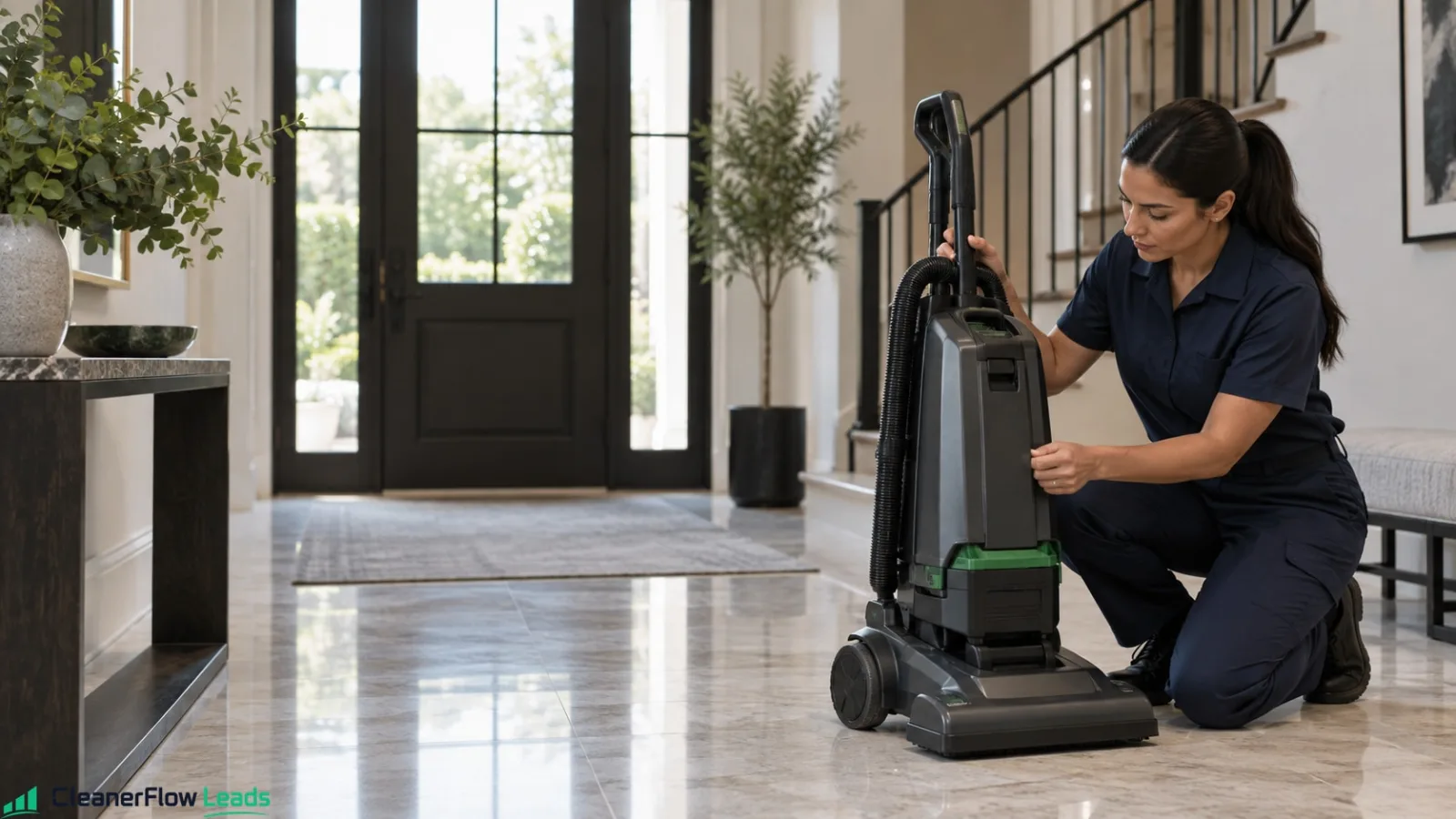
A good vacuum is a must-have, and the feature that matters most is a HEPA filter — it captures fine dust and allergens instead of blowing them back into the air and onto the surfaces you just cleaned (Novagems). For homes with pets, allergies, or kids, it's the difference between "looks clean" and "is clean." You don't need the most expensive industrial model to start — you need reliable suction, a HEPA filter, and something light enough to carry up stairs all day.
A mop system that lifts dirt instead of spreading it
An old string mop in a single bucket just moves dirty water around. A flat microfiber mop with washable pads — ideally a two-bucket setup or one that separates clean and dirty water — leaves floors actually clean and dries faster. It's also easier on your back over a full day. Washable pads mean no constant re-buying, which brings the cost per job right back down.
The starter kit: what every pro actually needs
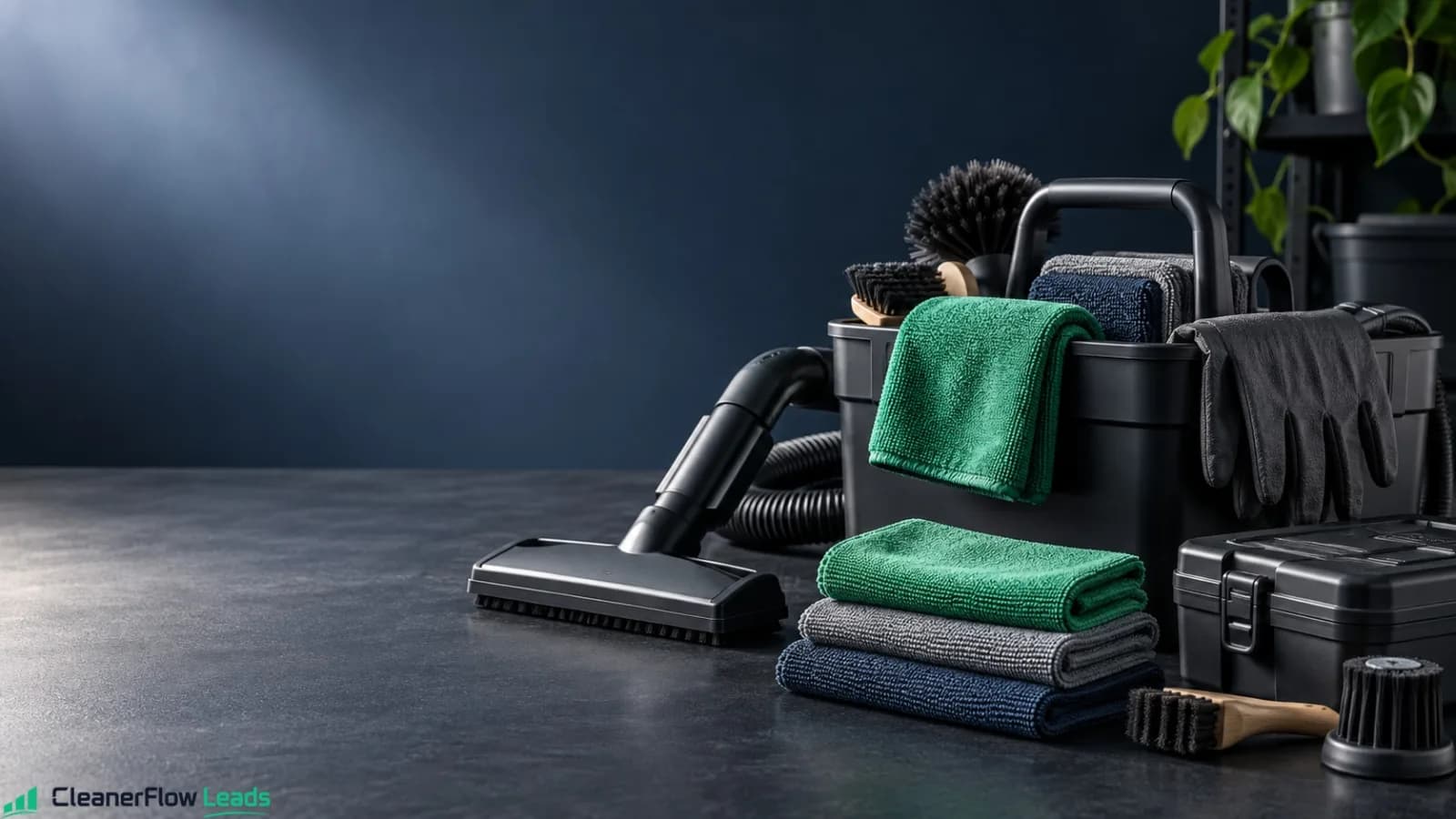
You can build a complete, professional kit around a short list (HouseCall Pro):
- Professional microfiber cloths (lots of them)
- A flat microfiber mop system
- A vacuum with a HEPA filter
- Scrub brushes and a grout brush
- Labeled spray bottles
- A quality all-purpose cleaner, a glass cleaner, a disinfectant, and a degreaser
- Gloves and basic safety supplies
- Trash bags
- A cleaning caddy to carry it all room to room
That's the whole foundation. Everything beyond it is a nice-to-have, not a need.
Color-code to avoid cross-contamination
This one is free and it protects both your client's health and your reputation: assign a cloth color to each area — say, blue for glass, green for kitchens, red for bathrooms — and never cross them. Wiping a kitchen counter with the cloth that just did a toilet is exactly the kind of thing that loses a client for good if they ever notice. A simple color system makes the right habit automatic.
Spend where it touches the result, save where it doesn't
The smart way to buy is to put your money where the client sees and feels it — cloths, vacuum, the products that leave a finish — and save on the things that don't change the outcome, like a fancy branded caddy or a gadget that does one niche task. Quality on the result-facing tools pays you back in speed, fewer callbacks, and the kind of finish that turns a one-time job into a recurring client. That connection between quality and retention is the whole point of keeping recurring clients.
What to skip
Skip single-use gimmicks, anything that promises to replace a good cloth and a good cleaner but does neither, and "as seen on TV" tools that break in a month. Be careful with ultra-cheap multi-packs of thin cloths — they're the false economy that creates callbacks. And you rarely need a different specialized product for every surface; a solid all-purpose cleaner, a glass cleaner, a disinfectant, and a degreaser cover almost everything.
Mistakes to avoid when you buy gear
Most bad purchases follow the same few patterns. Watch for these:
- Buying the whole catalog on day one. Start with the starter kit, work a few weeks of real jobs, and let those jobs tell you what's actually missing.
- Choosing by shelf price alone. The cheapest option usually costs more per job once you count re-dos and replacements.
- Buying a new product for every stain. A crowded caddy slows you down, and most of those bottles end up half-used in the trunk.
- Forgetting spares for the parts that stop a job. A broken vacuum belt, a clogged filter, or a worn-out mop pad can end your day early.
- Skipping the fit test on gloves and knee pads. Protective gear that hurts gets left in the car, and then it protects nothing.
Want leads in your area, not just theory?
Apply to buy cleaning leads →How to test a new product before it joins the caddy
A new cleaner should earn its place. Try it at home first, or on a hidden spot in a client's home, before you use it on a visible surface. Read the label for surface warnings and for how long it needs to sit before you wipe. Keep the room ventilated. Never mix products — bleach combined with ammonia or with acidic cleaners releases dangerous gases, so one product per task, rinsed between. And label every bottle you refill, with the product name and the date. A product you haven't tested is a risk you're taking with someone else's countertop.
Wash microfiber the right way
Good tools only stay cheap-per-job if you maintain them, and microfiber is where care matters most. Wash it separately from cotton (cotton lint clogs the fibers), skip the fabric softener (it coats the fibers and kills the grab), and air-dry or use low heat. Wash bathroom cloths in their own load, and retire any cloth that starts to streak or smell even after washing.
Keep the vacuum and mop working
Empty and rinse your vacuum and check the filter regularly, following the manufacturer's instructions for cleaning or replacing it. Cut hair and thread off the brush roll before it strains the motor, and check the belt when suction feels weak. Wash mop pads after every job so no house gets the last house's dirt. A little care doubles the life of everything in your caddy — which is just more margin in your pocket.
Your body is the real equipment — protect it
The most important gear isn't in the caddy; it's you. A long day of cleaning is hard on hands, knees, and your back, and an injury costs you far more than any tool. Buy good gloves that fit, knee pads for bathroom and floor work, supportive non-slip shoes, and a back-friendly vacuum and mop. Taking care of your body isn't a luxury — it's what lets you keep earning. A week on the sidelines costs more than the price of every tool combined.
A simple restock routine
Running out of cloths or cleaner mid-job is the kind of small failure that makes you look unprepared and slows you down. Keep a backup set in your vehicle, and once a week do a quick restock: count your cloths, top up your bottles, replace anything worn, and note what's running low. It takes a few minutes and saves you the scramble — and a client never sees you improvising with a half-empty bottle.
Should you bring your own supplies or use the client's?
Clients will ask. Bringing your own kit means you know exactly what touches every surface, you work at the same pace in every home, and your color system stays intact. Some clients do prefer a specific product — because of allergies, a fragrance they dislike, or a surface that needs special care. The simple approach: bring your kit by default, ask on the first visit whether there's anything they want you to use or avoid, and write the answer in that client's notes. Whatever your policy is, say it before the first clean, not at the door.
What goes in the caddy you carry inside
Gear you own but cannot reach is gear you do not have. Most lost minutes in a working day are spent walking back to the car, so it is worth deciding once where everything lives instead of deciding it again at every house.
In the caddy you carry inside, keep only what you use in every single room: your all-purpose spray, a degreaser, a glass cleaner, a bathroom product, a scrubbing pad, and a stack of color-coded cloths. Six things. A caddy you can lift with one hand while opening a door with the other is a caddy that comes with you upstairs, and a caddy that comes upstairs saves you trips on every floor.
What rides in the trunk
In the trunk, keep the second tier: the spare vacuum belt, replacement cloths, extra bin liners, the extension cord, the step stool, the grout brush, the oven product. These are the things you need only now and then. They do not belong in your hand; they belong a few steps away.
What stays home
At home stays everything you buy in bulk, plus anything with a strong smell you have not tested. Refilling from a large container into labeled bottles once a week is faster and much cheaper than carrying the big container around all week.
Two habits that keep the system working
First, weigh the caddy when it is full. If you cannot carry it up a flight of stairs comfortably with one hand, it is too heavy, and a caddy that is too heavy gets left at the bottom of the stairs — which puts every bottle in it far from where you need it.
Then two habits make the system hold. Restock the caddy the night before, never in the morning, because a missing bottle discovered at the start of the day costs you a shop run. And keep one sealed spare of the product you rely on most — the one where running out mid-job means you cannot finish. That single spare is worth more than any upgrade you could make to the rest of the kit.
The bottom line
Buy a small kit of the right things, spend where it touches the result, and treat the cost as a per-job number over the tool's life, not a price tag. The payoff is faster cleans, fewer callbacks, and a finish that keeps clients coming back — and how that fits into a business that grows is laid out in how to get cleaning clients. The gear that protects your time and your reputation always pays for itself.
Want requests from homeowners in your area? Apply to CleanerFlow Leads.
Sources
Luciano Rezende · Founder, CleanerFlow
Luciano founded CleanerFlow after years building tools for residential cleaning professionals. He writes about the economics of getting clients, pricing jobs, and running a cleaning business that lasts.
Cleaning jobs in your ZIP. You see the score before you pay.
Freshness, completeness, ZIP match and budget signal are all visible before you buy. If nobody answers, you don't pay.
- Refund if nobody answers
- Up to 3 buyers per lead
- 14 days to dispute
The rest of the toolkit
Turn a bought lead into a paying client.
Quote, schedule, message and get paid in one place — so the lead you paid for does not die in a group chat.
See CleanerFlow Pro →You already clean well. Now you can prove it.
Free modules in English, Portuguese or Spanish, and a certificate you can show a client (US$19.99 a year).
See the Academy →