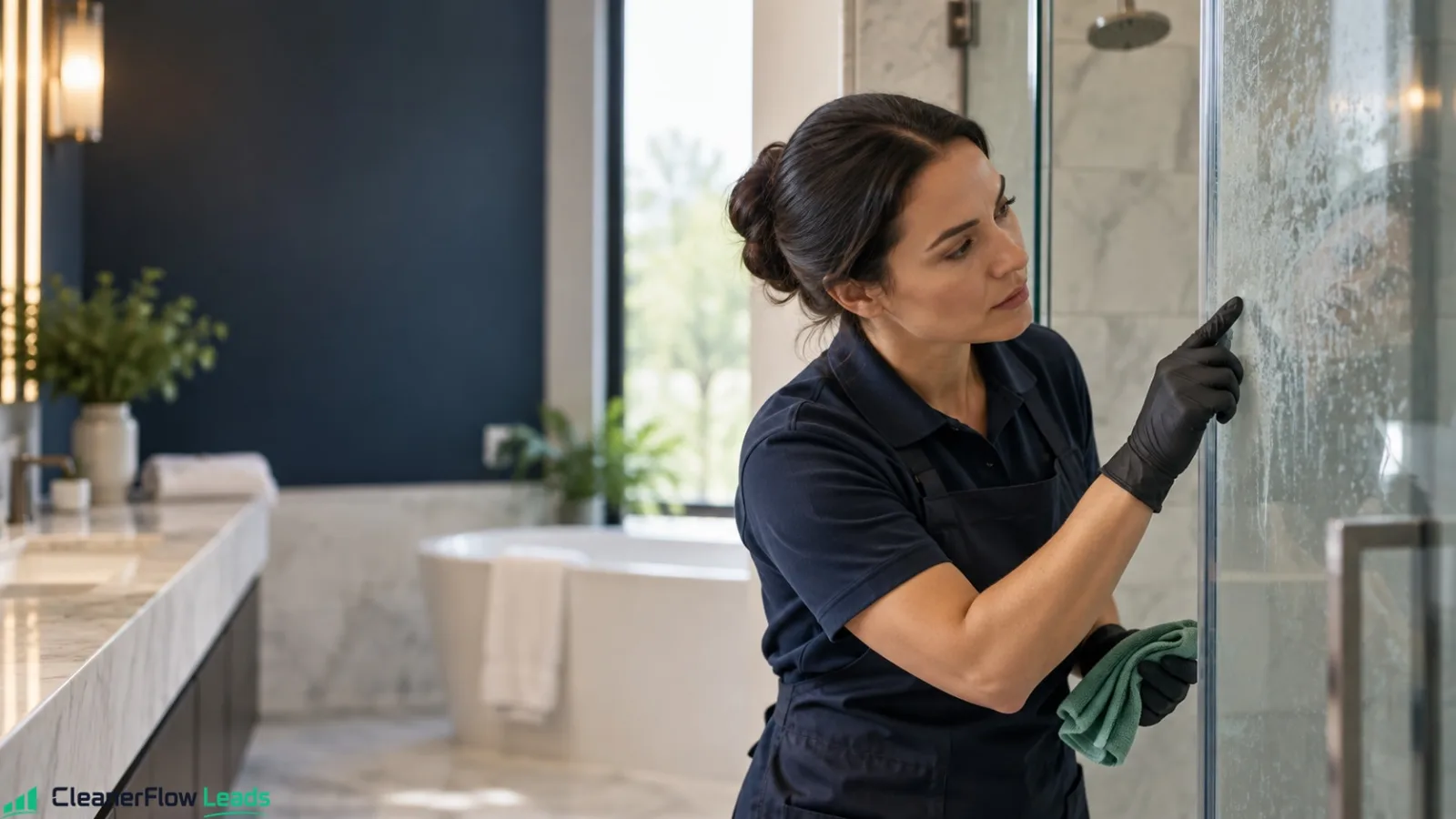
The white film on the shower screen that will not wipe off. The ring inside the toilet that comes back a week after you scrub it. The spots on the faucet that appear the moment the water dries. All of these are the same problem, and almost everybody attacks it the wrong way.
It is not dirt, and that changes everything
Hard water stains are mineral deposits — mostly calcium and magnesium — left behind when water evaporates and the minerals in it do not. The water leaves; the rock stays.
This matters because of what it rules out. Scrubbing harder does almost nothing, because you are trying to sand down a mineral crust with a sponge. A stronger detergent does almost nothing either, because detergent lifts grease and dirt, and this is neither.
What removes a mineral deposit is acid, and what makes the acid work is time. Once you understand that single sentence, every stubborn bathroom in your house becomes straightforward.
What you need before you start
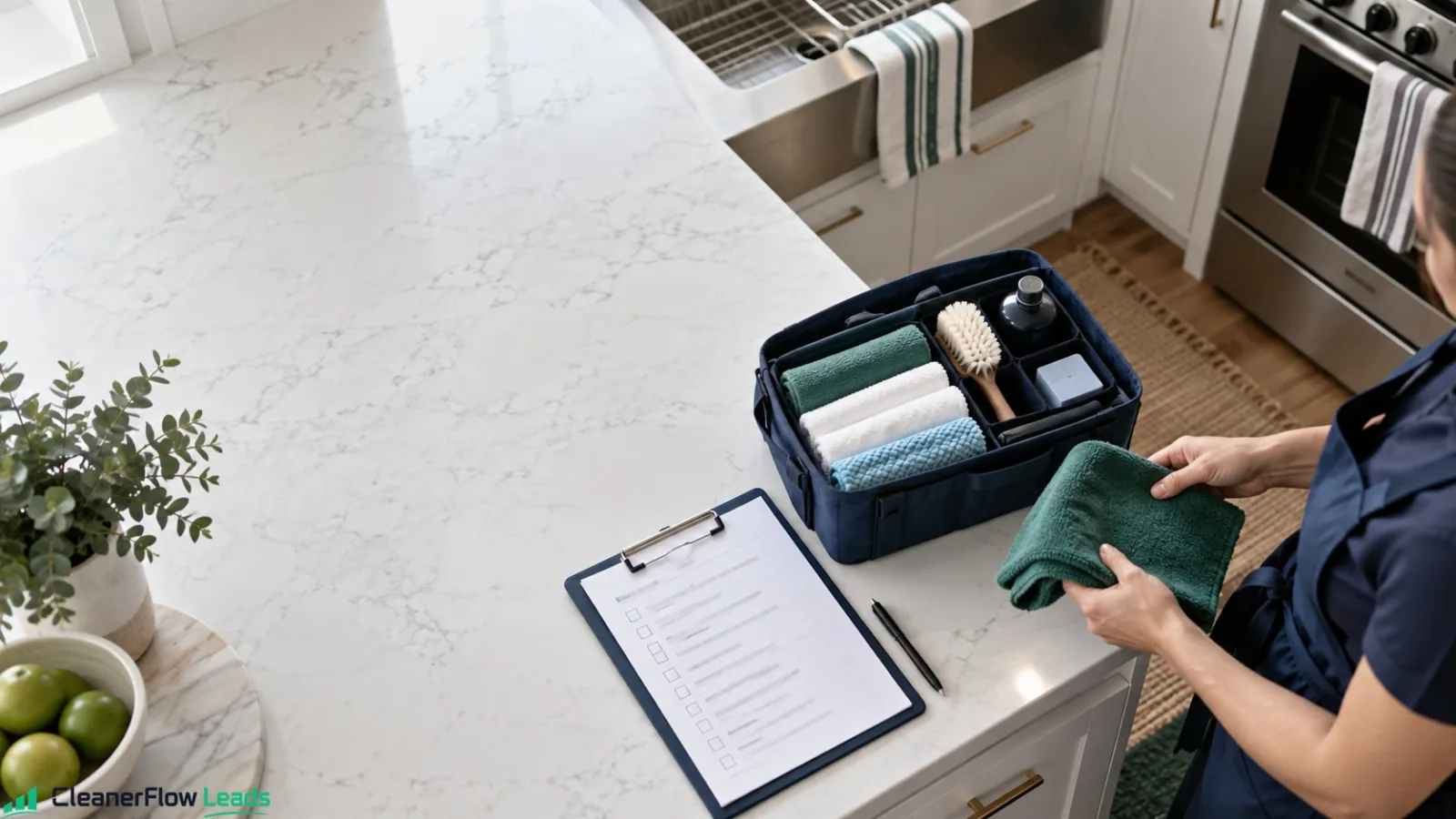
You do not need a cupboard full of products. For almost every hard water job in a home, this short list is enough:
- White vinegar for light and moderate deposits, or a commercial descaler or limescale remover for heavy ones.
- A spray bottle and a few microfiber cloths or paper towels.
- A non-scratch scrub pad and an old toothbrush for edges, drains and the base of faucets.
- A plastic bag and a rubber band, for showerheads that will not come off.
- A pumice stick made for toilets, if the ring in the bowl is heavy.
- Rubber gloves, and a squeegee for afterwards.
Read the label of every product before you use it, and check what each surface is made of. Those two checks prevent nearly every expensive mistake in this article.
The method: let it sit, do not scrub
The mistake is scrubbing for a long time. The method is waiting.
- Wet the surface so the product does not run straight off.
- Apply an acidic cleaner. White vinegar works for light and moderate build-up. A commercial descaler works faster and on heavier deposits.
- Keep it in contact. This is the step people skip. On a vertical surface like shower glass, spray the product onto a cloth or paper towel and press it flat against the glass, or use a product designed to cling. Liquid that runs into the drain is doing nothing.
- Wait for the time the product label recommends, and longer for heavy build-up. Do not let it dry out.
- Agitate gently, with a non-scratch pad or an old toothbrush for edges and around fittings.
- Rinse thoroughly and dry. Acid left on chrome or metal fittings can damage the finish over time.
Why contact time beats elbow grease
An acid dissolves a mineral deposit from the outside in, one thin layer at a time, and it only does that while it is wet and touching the deposit. The moment it runs off or dries, the work stops.
That is why the paper-towel trick is so effective on glass: it holds the liquid exactly where the crust is. It is also why a heavy deposit usually needs more than one round. Apply, wait, wipe away what has softened, and apply again to what is left.
For a really heavy deposit, two moderate applications beat one aggressive one, and both beat any amount of force. Force mostly scratches the surface around the stain, which then holds dirt and new deposits more easily than before.
Shower glass
The most common job and the most satisfying one. Acid, contact time, non-scratch pad, rinse, dry.
Work from the top down so drips land on areas you have not finished yet, and pay attention to the lower third of the panel and the edges near the frame, where water sits longest and the deposit is thickest.
If the glass has been neglected for years, the deposit may have etched the surface, and no product will bring back a perfect finish. At that point you are choosing between a specialist glass polish and replacing the panel. The next sections explain how to tell the difference before you spend an afternoon trying.
Chrome faucets and showerheads
For a showerhead, take it off if it comes off easily and soak it in a bowl of descaler or vinegar. If it does not come off, fill a plastic bag with the solution, tie it around the head with a rubber band so the nozzles are submerged, and leave it. This trick costs nothing and works better than anything you can do with a cloth.
On faucets, wrap a vinegar-soaked cloth around the base, where the crust collects, and leave it in place. Use the toothbrush around the aerator and the handle joints.
Always rinse chrome well afterwards and dry it. Acid left on a plated finish can dull it or wear through it over time.
The toilet bowl ring
The hard ring at the waterline is limescale. Lower the water level first — push the water down the trap with a toilet brush or scoop some out — so the product actually touches the ring instead of being diluted.
Then apply the descaler, wait, and brush. For a stubborn ring, use a pumice stick made for toilets, on porcelain only, always wet, and gently. A dry pumice stone can scratch the glaze, and scratched glaze stains faster afterwards.
If the ring returns quickly, look at the rim jets under the edge of the bowl as well. Mineral build-up there changes how water flows down the sides and leaves new deposits in the same place.
Tile and grout
Acid works on ceramic and porcelain tile, but check two things first. The tile must not be natural stone (see the warning below), and the grout must be in good condition. Acid on crumbling or unsealed grout will wear it down further.
Spray, give the product time, then scrub the grout lines with the toothbrush and wipe the tile faces with a cloth. Rinse well, because acid left in grout keeps working on it.
If the grout is visibly damaged, cleaning it harder will not solve the problem. That is a repair job — regrouting or resealing — and it is better to know that before you start.
Stainless steel sinks and appliances
Vinegar is usually fine on stainless steel, but it should never be left sitting. Apply, wipe, rinse and dry immediately.
Always finish by wiping in the direction of the grain, the faint lines in the metal. Wiping across them leaves streaks that look like dirt even when the surface is clean.
Avoid steel wool and abrasive powders here. They leave scratches that hold minerals and water spots, which means the problem returns faster than before.
Coated glass and protective finishes
Would you rather have someone else do this one?
Get up to 3 local cleaners →Some glass shower doors come with a factory coating that makes water bead and run off. Some modern showerheads, faucets and fixtures have special finishes — matte black, brushed brass and similar.
For anything described as coated, treated or protected, check the manufacturer's guidance before you use any acid. An acid can strip the coating you paid for, and once it is gone, the surface stains more easily than plain glass or metal.
When there is no guidance available, test the product on a small area that nobody sees, and use the mildest option first.
Rule one: never use acid on natural stone
Marble, travertine, limestone and some granites will etch — permanently dulling the surface — on contact with vinegar or any acidic descaler. The mark left behind is worse than the stain you were removing, and it cannot be cleaned off because it is damage, not residue.
Use a cleaner made specifically for stone, and follow its instructions. If you are not certain what the surface is, assume it is stone. Many vanity tops, shower benches and windowsills that look like tile or quartz are not.
This rule matters more than any tip in this article, because every other mistake here can be corrected, and this one usually cannot.
Rule two: never mix an acid with bleach
Vinegar, descaler and limescale remover must never be combined with chlorine bleach or with a product containing it. The combination produces chlorine gas, which is genuinely dangerous in a small bathroom with the door shut.
If you have used one, rinse the surface thoroughly before using the other, and ventilate. The same applies to toilet bowl cleaners, which often contain one or the other: read the label before adding anything to the bowl.
Two more rules, briefly: ventilate anyway, even with a single product, and wear gloves. Descalers are hard on skin.
How to tell hard water from what it gets confused with
Before you spend an afternoon on the wrong product, check which problem you actually have.
Hard water deposit is white, chalky, sits on top of the surface and feels slightly rough. Put a drop of vinegar on it: if it fizzes faintly or softens after a few minutes, that is what you have.
Soap scum is grayish, waxy and smears rather than flakes. It responds to a degreaser or an alkaline bathroom cleaner far better than to acid. Many showers have both, so the usual answer is a degreaser first, then the acid.
Etching is damage. The surface is dull but perfectly smooth, and no product changes it.
Mold and mildew is black or pink, lives in the grout and silicone, and needs a completely different product.
Home remedies that work
White vinegar. It is a mild acid, it is cheap, and it is the right tool for light and moderate deposits. Its limitation is strength, not principle — on a years-old crust it will take several long applications where a commercial descaler takes one.
Lemon juice. Same idea as vinegar, weaker, and it smells better. Fine for a faucet or a kettle, not for a shower screen that has been ignored.
A pumice stick, on porcelain only. Toilet bowls only, always wet, always gentle. Never on glass, chrome, enamel or stone.
Home remedies that do not work
Baking soda alone. It is alkaline, and the deposit is mineral. It is a mild abrasive, so it will polish slightly, and people mistake that for progress.
Baking soda plus vinegar. It does less than either one alone, because they neutralize each other. The dramatic fizzing is the reaction consuming both, leaving you with salty water. It is a wonderful science demonstration and a poor descaler.
Cola. It contains a weak acid, and it also contains sugar, which you then have to clean off. Use vinegar.
A melamine "magic eraser" pad works only partly. It is a fine abrasive, so it shifts a light film and also dulls a polished finish over time.
How long this should actually take
This is useful to know, because the main reason people give up is thinking the method has failed.
A shower screen with a light film is a short job: most of the time is waiting, and very little is wiping. A screen that has been neglected for a long time usually needs two applications and may need a second session on another day. A toilet ring is mostly waiting too. A showerhead soaking in a bag can be left overnight, and your actual effort is a couple of minutes.
If you have spent a long time scrubbing and nothing has changed, stop. You are either fighting the wrong problem — etched glass rather than deposit — or the product never had enough contact time. More force is never the answer here; more patience usually is.
Common mistakes to avoid
- Scrubbing a dry surface. It scratches and removes almost nothing.
- Letting the product run off a vertical surface into the drain.
- Using abrasive powders or steel wool on glass, chrome or stainless steel.
- Mixing products, especially an acid with anything containing bleach.
- Skipping the rinse. Acid left behind keeps working on finishes and grout.
- Assuming a surface is tile when it might be natural stone.
- Treating etching as dirt and trying ever-stronger products on damage that cannot be cleaned.
Stopping it coming back
Removal is a job. Prevention is a habit, and the habit is much cheaper.
A squeegee on the shower glass, after every shower. It takes seconds, and it prevents more build-up than any product removes, because water that is not left to evaporate leaves nothing behind.
Dry the faucets after cleaning. The spots appear as water dries, so the last step of cleaning a bathroom should always be drying the metal.
Leave the bathroom door open and the fan running after a shower. Faster drying means less deposit and far less mold.
Do not let it build. A light film wipes off quickly with vinegar. The same film left for months needs a specialist product and an afternoon.
Can hard water stains become permanent?
On glass, yes. When mineral deposits sit on glass for a long time, they can etch it, and the cloudiness that remains is a change in the glass itself. Cleaning products cannot reverse that; only polishing or replacement can.
On porcelain, chrome and ceramic tile, deposits are usually removable with patience, as long as nobody has damaged the surface by scrubbing it with the wrong tools.
On natural stone, the deposit itself is removable with a stone-safe product, but a wrong attempt with acid causes permanent etching. That is why the stone rule comes first.
When the answer is not a product
If the deposit comes back within weeks, everywhere in the house — kettle, faucets, glassware coming out of the dishwasher cloudy, laundry feeling stiff — you do not have a cleaning problem. You have hard water, and you are treating the symptom every weekend.
The permanent fixes are a water softener for the whole house, or a filter at the shower or the point of use. Whether that is worth it depends on how hard your local water is and how much time and product you are currently spending. It is worth pricing once.
And if you use a cleaning service, tell them. Hard water is a very common reason a bathroom looks less than perfect after a competent clean, and knowing about it changes the product and the time the cleaner allows — which is a better conversation than quietly wondering why the glass is still cloudy.
Need a cleaning? Send a free request — up to three approved local cleaners can reply.
Luciano Rezende · Founder, CleanerFlow
Luciano founded CleanerFlow after years building tools for residential cleaning professionals. He writes about the economics of getting clients, pricing jobs, and running a cleaning business that lasts.
Three trusted local cleaners — without the flood of spam calls.
Tell us what you need once. We share it with up to three qualified local pros, whoever takes it reaches out, and you pick from those who do.
- Up to 3 pros
- No account, no spam
- Stop any time