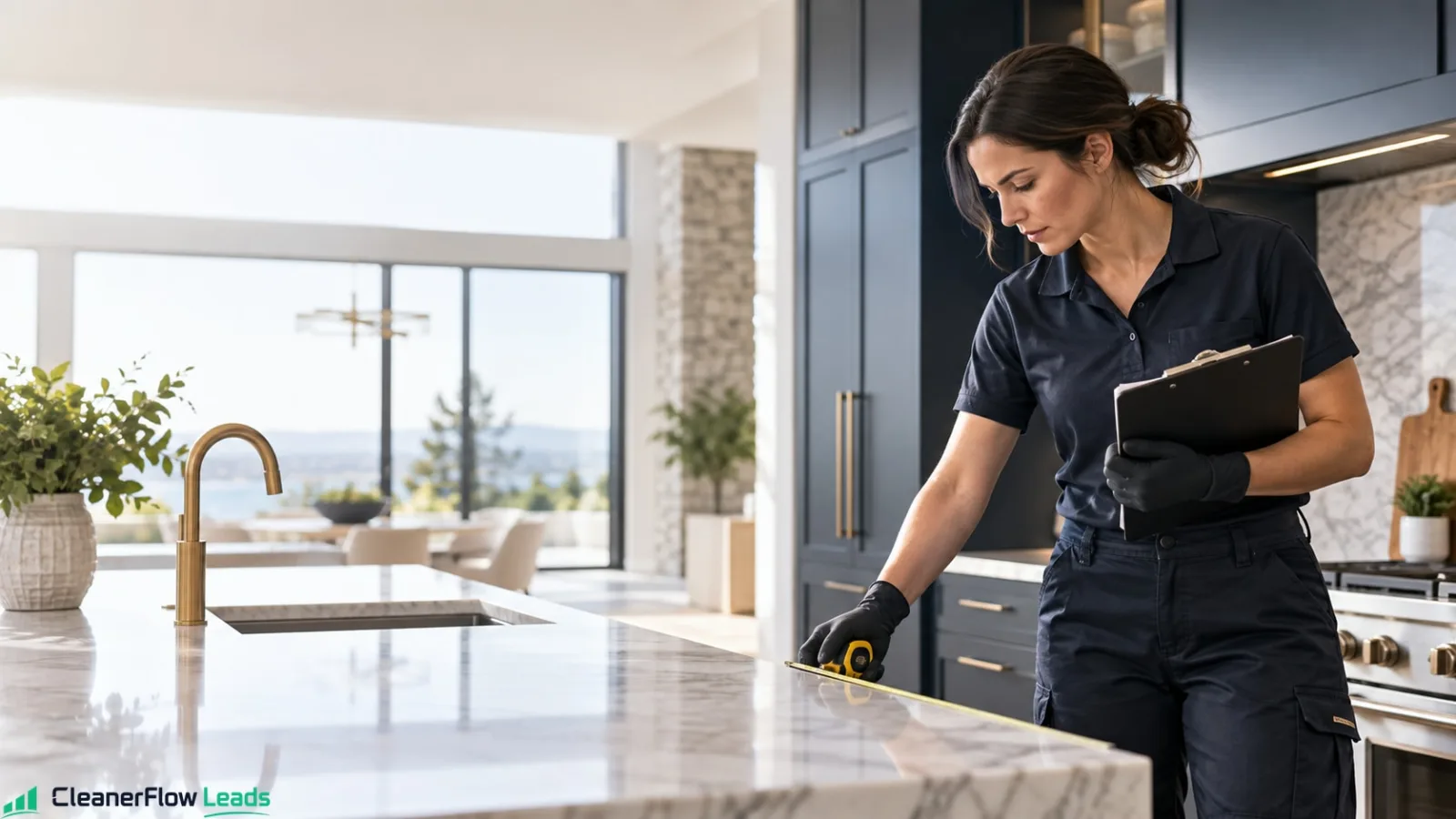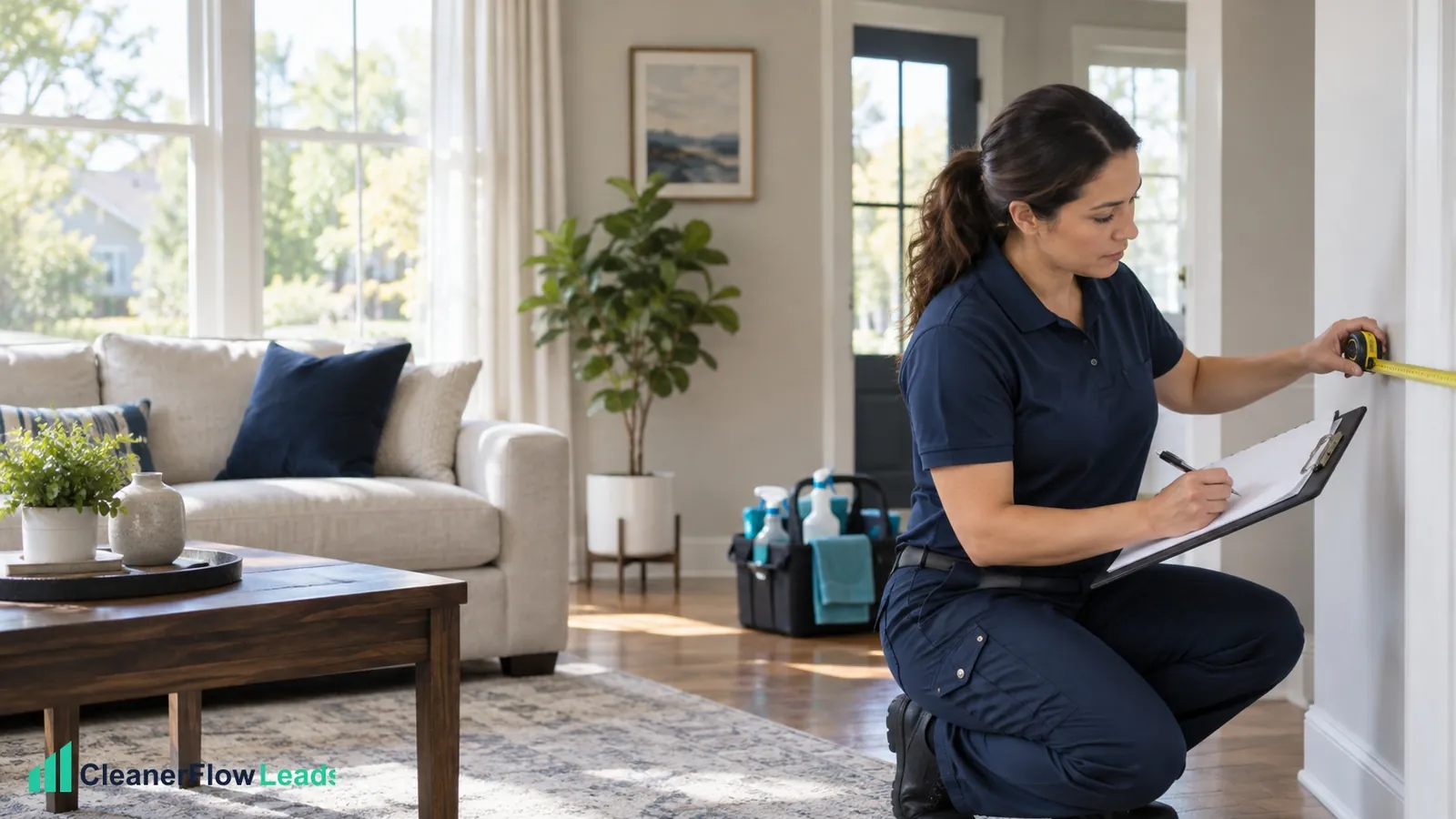
The quote is the moment the job is won or lost. Most cleaners treat it as a number to blurt out on the phone — and then wonder why the client "went with someone else." A good quote does two jobs: it prices the work so you actually profit, and it convinces the client you're the professional to trust with their home. Here's exactly how to build one that closes, time after time.
Quote in person, or with a walkthrough, whenever you can
A price given blind over the phone is a guess, and guesses cost you — too high and you lose the job, too low and you work for free. Whenever the job is worth it, see the space first: a short walkthrough, a video call, or detailed photos. You'll price accurately, spot the deep-clean add-ons, and — just as important — the client meets a real professional instead of a faceless number. That visit is often what closes the job before you've even said the price.
What to look at during the walkthrough
A walkthrough only helps if you know what you're looking for. Walk the home in the order you would clean it and note the things that change your time:
- Size and layout: number of bedrooms, bathrooms, and floors, and whether there are stairs to carry gear up.
- Kitchen and bathrooms: these take the most time. Look at grease on the stovetop, buildup in showers, and the state of the grout.
- Pets: shedding animals mean more vacuuming and more hair on upholstery.
- Clutter: you clean surfaces, not piles. If surfaces are covered, ask whether the client will pick up first.
- Special surfaces: stone counters, hardwood, or delicate fixtures that need specific products.
- Access: parking, gate codes, keys, and where you can fill a bucket.
Then ask the most important question of the visit: "What matters most to you when this is done?" The answer tells you where to spend your effort — and gives you the words to use when you present the price.
Price the job, not the hour
Charging by the hour is the most common mistake in cleaning. It punishes you for being good: the faster and better you get, the less you earn. It also scares clients, because an open-ended hourly bill feels like a blank check. Quote a flat price for the job instead. You keep the upside of your own speed, and the client knows exactly what they'll pay.
How to build your flat price
A flat price is not a number you feel good about; it's arithmetic. Build it the same way every time:
- Estimate your time for this specific home, based on what you saw in the walkthrough.
- Multiply by the hourly rate you actually want to earn — not the rate you think the client wants to hear.
- Add your real costs: supplies used on the job, travel time and fuel, and any gear wear.
- Add your margin so the business can cover slow weeks, taxes, and replacing equipment.
Keep the time estimate to yourself. The client sees one clear number for one clear result. If you finish early because you're skilled, that's the reward for your skill, not a refund owed to anyone.
What to put in the quote
A quote isn't just a number; it's a small promise. Spell out what's included so there's no argument later: the rooms and tasks covered, anything extra (inside the oven, inside the fridge, windows, baseboards), the price, and when you can start. Clarity here prevents the awkward "I thought that was included" conversation and makes you look organized — which is exactly what a client hiring a stranger to enter their home wants to see.
Anchor on the outcome, not the lowest number
The cheapest quote rarely wins, and when it does, it usually loses money. Instead of competing on price, sell the result: a spotless home, done on time, every time, by someone they can trust with a key. When you lead with the outcome and the reliability, price becomes one factor instead of the only one. Clients pay more for certainty than for a discount — give them certainty.
Make the quote easy to say yes to
How you deliver the quote matters as much as the number itself. Send it the way the client already communicates — a clear text or a short written message they can read in seconds, not a phone call they have to schedule for later. Put the price, what's included, and the next step in plain language, and end with a simple yes-or-no question ("want me to book Thursday at 9?"). Every extra step between the client and "yes" is a chance to lose them to the next cleaner. A quote that's quick to read and quick to accept will out-close a lower price buried in a voicemail every time.
Confirm the booking in writing
Once they agree, confirm it in writing — date, time, price, and scope — so the job starts with zero confusion and no room for an argument later. A short message is enough: "Confirmed: standard clean Thursday at 9, kitchen, two bathrooms, bedrooms and living areas, at the price we discussed." That one message protects both of you. If anything is questioned later, you both have the same record of what was agreed.
Quote fast — speed is part of the price
Speed isn't just about answering the phone; it applies to the quote too. Most homeowners hire the first pro who gets back to them with a real answer (Verse.ai). A clear quote sent quickly beats a perfectly polished one sent the next day. If you can't give a firm number on the spot, give a confident range and a time you'll confirm — then confirm when you said you would. We cover the first conversation in depth in how to win the first call.
Follow up once, professionally
A quote with no follow-up leaves money on the table. If you haven't heard back in a day or two, send one short, friendly message: restate the price, the value, and an easy next step ("happy to hold Thursday morning for you"). One good follow-up is professional; pestering is not. The goal is to make saying yes effortless.
Want leads in your area, not just theory?
Apply to buy cleaning leads →Give a range now, a firm number after you see it
Sometimes you have to quote before you can see the place. Don't refuse and don't lowball — give an honest range based on the size and type of job, and say clearly that you'll confirm the exact number once you see it. A confident range keeps you in the running, sets expectations, and protects you from underpricing. Then lock the firm number the moment you have eyes on the space. Clients respect a pro who won't pull a random number out of the air.
Price the recurring client on purpose
A one-time clean and a standing biweekly are not the same product, and they shouldn't carry the same logic. A recurring client is worth far more over time, so it's worth a small, deliberate discount to win and keep the slot — a lower per-visit price in exchange for a regular schedule. You trade a little margin per visit for predictable income and far less time chasing new work. Quote the one-time price, then offer the recurring rate as the better deal it actually is. Why that math favors you is laid out in recurring client retention.
When they say "that's too much"
Price pushback isn't a no — it's a request for a reason. Don't flinch and don't immediately cut the number, because dropping your price the second it's questioned tells the client it was inflated to begin with. Instead, restate the value: what's included, the reliability, the result. If they still need a lower number, reduce the scope, not just the price — leave the inside of the oven or the windows for another visit — so your rate stays intact and the client still feels heard. A pro adjusts the job; an amateur just discounts.
What you should actually charge
Know your local numbers before you quote. Across the US, a standard house cleaning runs about $175 a visit, with most jobs landing roughly between $120 and $240, or about $0.10 to $0.20 per square foot (HomeGuide). Deep cleans, move-outs, and first-time visits command more because they take more. These are starting points, not gospel — your real floor is your own cost plus the margin you need. If you don't know what a job is truly worth to you, read how much a lead and a job are actually worth.
Common quoting mistakes to avoid
Most lost quotes come from the same handful of habits:
- Quoting before asking questions. A number without context is a guess, and the client can tell.
- Leaving the scope vague. "Clean the house" means different things to different people. Write it down.
- Matching every competitor's price. You don't know their costs, their quality, or whether they'll show up.
- Apologizing for your price. Saying "I know it's a lot" invites the client to agree with you.
- Forgetting travel. A job far across town costs you more time than the hours inside the home.
- Never raising prices. Your costs go up every year; a price you set once and never touch shrinks over time.
When the house is worse than it looked, say so before you start
Every cleaner has walked into a job that was quoted from photos or a phone call and found something else entirely: a kitchen that has not been touched in a long time, a bathroom with real damage, pets nobody mentioned. What you do in the first few minutes decides whether that day costs you money.
The instinct is to say nothing, work faster, and absorb it. That is the most expensive option available. You lose the hours, you produce a rushed result, and you set a price for the next visit that is already wrong.
Say it immediately, before you open a bottle, and say it in one calm sentence: "I want to flag something before I start — the kitchen is going to take quite a bit longer than what we discussed. I can do the full job at X, or I can stay within the original price and focus on the bathrooms and the floors. Which would you prefer?"
Why that conversation works
That sentence works because it does three things at once. It tells the truth early, when the client can still choose. It gives two options instead of a demand, which almost never triggers an argument. And it never asks anyone to pay for work they did not agree to.
Say it standing up, with your hands empty, before you have carried anything in. Once you have started unpacking, you are interrupting your own work, and most people find that much harder to raise. Most clients pick the higher price. They can see the kitchen too, and they usually already knew. The ones who pick the cheaper option are telling you something useful about the next visit.
What you must not do is finish the job and then send a bigger invoice. A price changed after the work is done reads as a trap, even when it is completely fair — and it is the fastest way to turn a one-time client into a complaint.
Put the condition clause in the quote itself
You can make that conversation easier before it ever happens. Add one line to every quote: the price applies to the home in the condition described, and any major difference will be discussed before work begins. Now the talk at the door is not a surprise — it's something the client already read and accepted. That single line protects your time and keeps the relationship friendly.
Your pre-send quote checklist
Before you hit send, run through this list:
- Did I see the space, or at least photos or a video?
- Is the scope written out room by room, with extras named?
- Is it one flat price, not an hourly rate?
- Does the price cover my time, supplies, travel, and margin?
- Did I include the condition clause?
- Does the message end with a clear next step and a specific time slot?
- Am I sending it while the client is still waiting for an answer?
If every box is checked, the quote is ready.
How do I raise prices for existing clients?
Raise them the same way you quote: clearly and without apology. Give recurring clients advance notice in writing, say when the new price starts, and tie it to the value you deliver and your rising costs. Many cleaners apply new rates to new clients first and move long-standing clients later, which keeps loyal relationships steady while your pricing catches up. What you should avoid is raising prices silently on an invoice — that damages trust far more than the increase itself.
A quote is a sales tool, not a formality. Price the job for profit, present it with confidence, send it fast, and follow up once. Do that consistently and your close rate climbs — which, as we explain in how to get cleaning clients, is the cheapest growth there is.
Want requests from homeowners in your area? Apply to CleanerFlow Leads.
Sources
Luciano Rezende · Founder, CleanerFlow
Luciano founded CleanerFlow after years building tools for residential cleaning professionals. He writes about the economics of getting clients, pricing jobs, and running a cleaning business that lasts.
Cleaning jobs in your ZIP. You see the score before you pay.
Freshness, completeness, ZIP match and budget signal are all visible before you buy. If nobody answers, you don't pay.
- Refund if nobody answers
- Up to 3 buyers per lead
- 14 days to dispute
The rest of the toolkit
Turn a bought lead into a paying client.
Quote, schedule, message and get paid in one place — so the lead you paid for does not die in a group chat.
See CleanerFlow Pro →You already clean well. Now you can prove it.
Free modules in English, Portuguese or Spanish, and a certificate you can show a client (US$19.99 a year).
See the Academy →