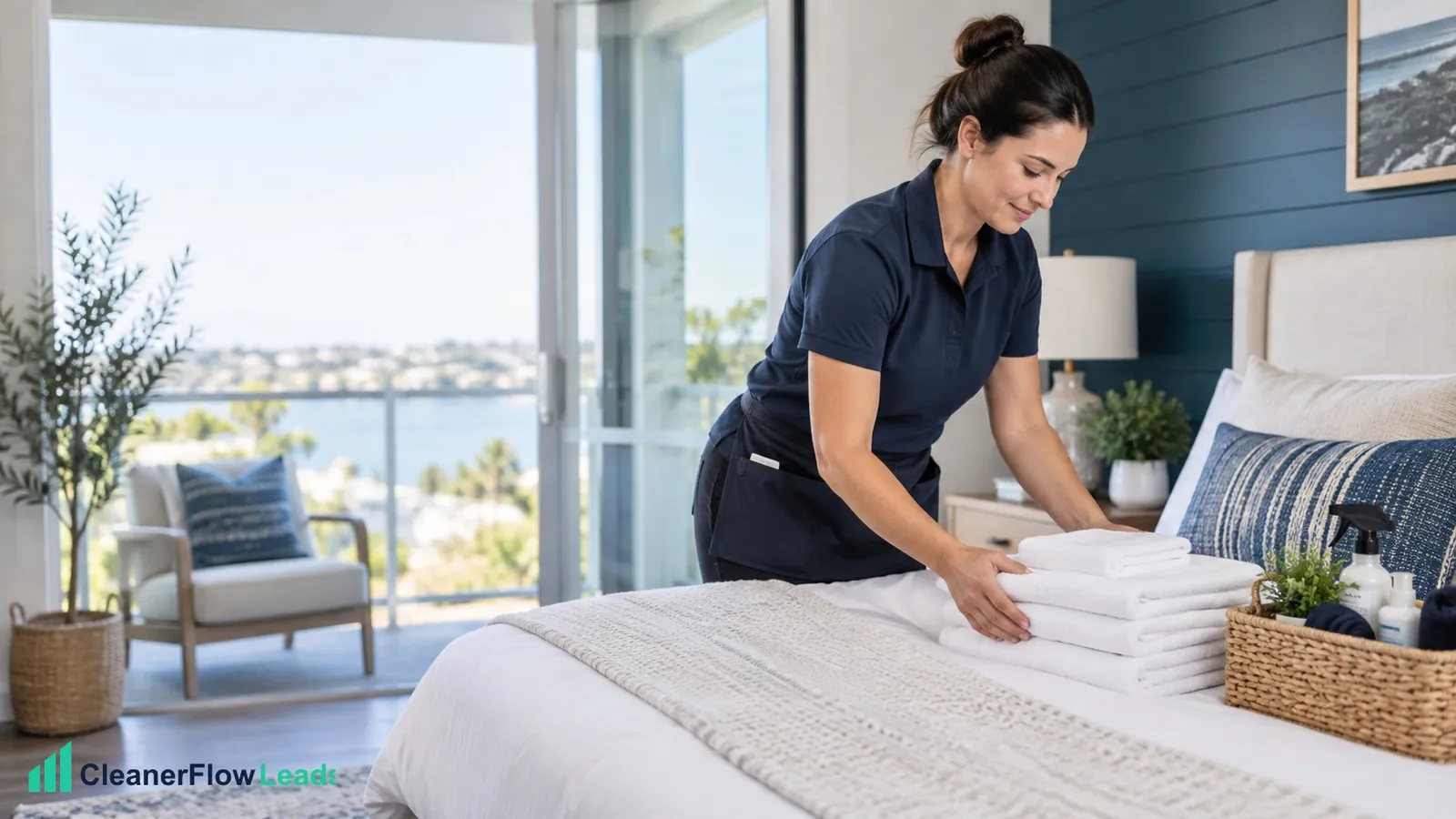
Most cleaners treat Airbnb turnovers as small jobs — a quick wipe-down for less money than a real house clean. That's exactly backwards. A short-term-rental turnover pays less per job and often more per hour than most residential work you can book, and a single property can out-earn a long list of one-off clients over a year. The catch is that hosts aren't buying cleaning. They're buying speed, reliability, and the freedom to never think about it again — and that's what you price for.
Why one host beats a stream of one-off clients
A one-off deep clean is a single transaction: you clean once, you get paid once, and you go looking for the next stranger. A short-term rental is the opposite. A popular Airbnb turns over 15–20 times a month, so even at $75 a turnover that's $1,125–$1,500 a month from a single address (Turno). Land a few of those and a large share of your week is covered by keys you already know how to reach.
Volume replaces selling
That volume is the whole game. The hardest, most expensive part of any cleaning business is finding the next client — which is why getting cleaning clients is the work most cleaners underestimate. A host who turns over twice a week hands you that volume from one relationship. You stop selling and start servicing, and your effective cost of acquiring work drops to almost nothing.
Density: build a route, not a scatter
There's a second advantage hiding in that volume. Short-term rentals cluster — beach towns, downtown cores, ski areas — so once you have one account in a building or neighborhood, the next is often a short drive away. A tight cluster of turnover properties lets you stack several jobs into a single day with minimal travel between them, and travel time is dead time you don't get paid for. Build a route of nearby rentals and your real hourly earnings climb again, because the gaps between paying work shrink.
What turnovers typically pay
Turnover cleaning is priced lower per job than a standard home clean — and that scares cleaners off. It shouldn't. A turnover is a shorter, tightly scoped reset between guests, so each visit pays less than a full residential clean. What it gives back is volume and predictability from a single address.
Why per hour beats per job
Look only at the sticker and turnover loses. Look at the clock and it often wins. A residential deep clean can eat three or four hours; a turnover is a fixed, repeatable scope done in one to two (Uplisting). Divide each price by the hours it actually takes you and compare. Turnovers frequently come out ahead per hour — and the turnover comes back next week with no selling required, so it wins again on consistency. Do this math with your own prices and times before you decide which work to chase.
Hosts pay a premium for reliability
Here is the part cleaners miss. The biggest complaint hosts have about cleaning services isn't quality — it's reliability. Whoever cleans has to show up on time, every time, because one missed turnover costs the host a booking, a bad review, and their reputation (LeadDuo).
Why cleanliness scores give you leverage
That fear is your leverage. Cleanliness is the single biggest driver of bad reviews, 81% of travelers rank it as their top booking priority, and listings rated 4.8+ on cleanliness get about 20% more bookings (One A Cleaning). To a host, you are not a chore — you are what stands between the listing and a one-star review. Be the cleaner who never no-shows and you stop being a vendor they shop around and become infrastructure they protect. That is what makes turnover accounts so sticky, and it's the same logic behind keeping recurring clients for the long haul.
The checkout-to-check-in window
A residential clean has slack; a turnover does not. Checkout is usually 11am and check-in 3pm, which leaves a real working window of one to two hours to strip beds, run laundry, sanitize bathrooms, restock, stage, and photograph — and it shrinks fast when the last guest leaves wet towels in every room or asks for an early check-in (Uplisting). That pressure is exactly why turnover commands more per hour than a leisurely home clean, and you should price it in.
What to charge extra for
Quote the standard turnover, then add a clear premium for:
- True same-day rush windows.
- Laundry handled on site.
- Restocking consumables.
- Photo documentation of a guest-ready space.
Each is real work, each protects the host's review score, and each is worth paying for. Write them down as separate lines so the host sees exactly what the base price covers.
Backup availability is a product you can sell
Want leads in your area, not just theory?
Apply to buy cleaning leads →Hosts live in fear of the last-minute gap — the regular cleaner cancels, a same-day booking lands, and the unit has to be guest-ready within hours. A cleaner who can say "call me and I'll cover it" is selling something most can't: insurance. You can price backup availability as a small monthly retainer or a higher rush rate, and hosts will pay it gladly, because the alternative is a cancelled reservation and a furious guest. Be the one whose phone gets answered and you'll win the account over a cheaper option that only does scheduled visits — often on the very first call.
How to actually win these accounts
Hosts choose turnover cleaners on confidence, not price. Lead with reliability: a simple checklist you follow every time, a habit of sending guest-ready photos when you finish, and a promise that you confirm the night before. Quote a flat per-turnover rate so the host can budget against the cleaning fee they charge guests, and make your same-day and laundry premiums explicit so there are no surprises. Then deliver the same clean, the same way, every single time — because the entire value of a turnover account is that the host never has to think about it.
What to send the host after every turnover
A short, consistent message after each job does more for retention than any discount. Keep it to the same few items every time:
- Photos of each room as the guest will see it.
- Anything broken, stained, or missing, with a photo.
- Supplies that are running low.
- Anything that needs the host's attention before the next guest.
Hosts manage from their phones, often from far away. A predictable report lets them relax — and makes you very hard to replace.
A year with one Airbnb, worked out
Run the arithmetic on a single two-bedroom that turns over twice a week. That's roughly 104 turnovers a year. Multiply your own turnover rate by that number and you have a year of work from one address, one relationship, one route you already drive — before any same-day premiums or backup retainer. Compare that to chasing dozens of one-off cleans to earn the same amount, each one a fresh sale, a fresh stranger, a fresh no-show risk. The turnover account isn't the small job. It's the anchor the rest of your week gets built around.
Linens: decide who owns them
Turnover work has a hidden line that regular house cleaning does not, and it is one of the most common reasons a host account that looked profitable is not. Decide who owns it before you quote, not after.
Somebody has to wash, dry, fold and replace sheets and towels between guests. If that somebody is you, it is not a favor — it is machine time you do not control, and it happens in your day whether the dryer cooperates or not. There are three honest arrangements: the host keeps enough spare sets on site so you swap and leave the dirty ones, the host uses a laundry service, or you do the laundry and it is a separate line on your price. All three work. What does not work is it being nobody's job and therefore quietly yours.
Consumables: stocked by the host, flagged by you
Toilet paper, paper towels, bin liners, dish tablets, soap, coffee, sponges. Individually trivial, and across a month of turnovers, not trivial at all. The clean answer is that the host stocks a labeled supply cupboard and you message when something is running low. The expensive answer is that you buy them and remember to invoice, because you will not always remember.
Damage and missing items
You are the last person in the property and the first to see what the guest did. Agree in advance what you do about a broken glass or a stain: photograph it, send it, and move on. Never decide on your own whether something is worth mentioning. A quick photo protects you from a conversation days later about who broke what.
Put linens, consumables, and damage in writing before the first turnover, and the account stays as profitable in month six as it looked in month one.
Mistakes that turn a good account into a bad one
- Quoting before seeing the property. Photos hide stairs, parking problems, and a washer that takes forever.
- Absorbing the rush jobs for free. One favor becomes the expectation.
- No confirmation the night before. Calendars change; a quick check prevents a wasted trip.
- Skipping photos on a busy day. The one day you skip is the day a guest complains.
- Letting scope creep in. Oven, fridge, or patio work is extra unless your price already includes it.
Questions to ask a host before the first turnover
- How do I get in, and what happens if the lock or code fails?
- Where are the spare linens and the supply cupboard?
- Who handles laundry, and where?
- What does "guest-ready" look like to you — can you send a photo of how you want each room staged?
- How do you want me to report damage or missing items?
- How much notice do you give for same-day bookings, and how do you want to pay for them?
Getting these answers once saves you from guessing on every visit.
The bottom line
Airbnb turnover cleaning looks like low-value work and is actually some of the highest-leverage work a cleaner can take on. It often pays more per hour than it looks, it repeats without selling, and it rewards the one thing most cleaners can deliver but few promise: showing up, every time, with the place ready. Price the speed, price the reliability, sell the backup, and one host can become the most profitable account on your books.
Want requests from homeowners in your area? Apply to CleanerFlow Leads.
Sources
Luciano Rezende · Founder, CleanerFlow
Luciano founded CleanerFlow after years building tools for residential cleaning professionals. He writes about the economics of getting clients, pricing jobs, and running a cleaning business that lasts.
Cleaning jobs in your ZIP. You see the score before you pay.
Freshness, completeness, ZIP match and budget signal are all visible before you buy. If nobody answers, you don't pay.
- Refund if nobody answers
- Up to 3 buyers per lead
- 14 days to dispute
The rest of the toolkit
Turn a bought lead into a paying client.
Quote, schedule, message and get paid in one place — so the lead you paid for does not die in a group chat.
See CleanerFlow Pro →You already clean well. Now you can prove it.
Free modules in English, Portuguese or Spanish, and a certificate you can show a client (US$19.99 a year).
See the Academy →